Dubai has developed into a leading business destination that attracts entrepreneurs from all over the world. The city functions as a global innovation hub because of its strategic location, advanced infrastructure, and supportive government policies. Before diving in, it’s essential to understand the different jurisdictions available for company formation in Dubai, as this choice will shape how your business operates and grows.
Understanding Business Jurisdictions in Dubai
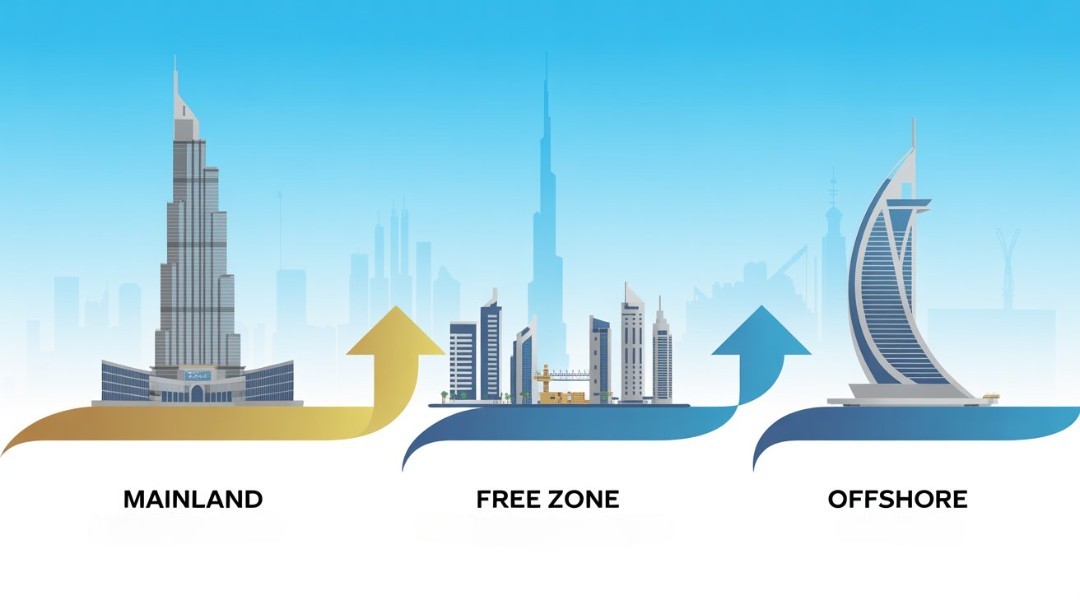
When planning your business in Dubai, you’ll encounter three main jurisdictions.
Mainland
Licensed by the Dubai Department of Economy and Tourism (DET), Mainland companies are allowed to operate across the UAE and internationally.
Free Zone
An independent jurisdiction that offers specialized facilities and efficient trade processes that serve international business needs.
Offshore
Entities registered for asset protection, holding companies, or global trade, but are not permitted to operate directly within the UAE market.
Each jurisdiction has its own rules, benefits, and limitations. Understanding them is the first step toward a successful business setup in Dubai.
Mainland companies serve as the most flexible business choice because they provide access to both domestic and international markets.
Key Features
Licensed by the Dubai Department of Economy and Tourism (DET).
Allowed to conduct business operations throughout the UAE and internationally.
Requires establishing an actual office location within Dubai.
Subject to corporate tax regulations.
Advantages
No restrictions on conducting trade activities throughout the entire UAE.
Able to work with government contract work.
A wide range of business activities permitted.
Limitations
Compared to free zones, high setup costs are required.
Mandatory to establish office space.
Free Zones use specialized business facilities and simple operational procedures to bring in international investment.
Key Features
Regulated by individual Free Zone authorities.
Primarily for international trade purposes, with limited access to the UAE market.
Flexible office space solutions, including shared desk and virtual office services.
Subject to corporate tax, but certain Free Zones provide incentives to their businesses.
Advantages
Provides an efficient process for establishing new operations.
Provides dedicated facilities for various industries, including technology, media, and logistics.
Allows complete foreign ownership of businesses.
Limitations
Direct trading rights between the UAE mainland and international markets are restricted.
Either select a distributor or establish a branch office to conduct business operations on the mainland.
Offshore companies are ideal for entrepreneurs who focus on asset protection, wealth management, or international trade.
Key Features
It is regulated by Jebel Ali Free Zone (JAFZA) Offshore or Ras Al Khaimah International Corporate Centre (RAK ICC).
Designed for international trade, holding assets, or wealth management.
No physical office required in Dubai.
Subject to international tax compliance regulations.
Advantages
Confidentiality of ownership and assets.
Cost-effective setup.
Suitable for holding companies or companies that operate internationally.
Limitations
Not allowed to conduct business within the UAE market.
Limited operational flexibility when compared to Mainland or Free Zone setups.
The following are some of the main differences between Mainland, Free Zone, and Offshore companies.
Market Access
Mainland companies operate their businesses throughout the entire UAE territory and international markets. Free Zone companies focus on international trade operations, but they must comply with restrictions that limit their access to the UAE market. Offshore companies are limited to performing only international operations.
Ownership
All three jurisdictions now allow 100% foreign ownership, which enables entrepreneurs to hold total control.
Office Requirements
The Mainland mandates companies to maintain a physical office, whereas Free Zones provide businesses with multiple office space options, and Offshore entities maintain no office requirements.
Taxation
Corporate tax applies to Mainland and Free Zone companies, while Offshore entities must comply with international tax regulations.
Best Use Case
The Mainland serves as the optimal location for both local and international trade activities, whereas Free Zones operate as dedicated areas for startup businesses and international companies, and Offshore functions as the perfect solution for safeguarding assets and establishing holding companies.
The following is a step-by-step guideline for anyone considering a business setup in Dubai.
Define Your Business Activity - Decide whether you want to trade locally, internationally, or manage assets.
Choose Jurisdiction - Select Mainland, Free Zone, or Offshore based on your goals.
Select Legal Structure - Options include LLC, branch office, sole proprietorship, or holding company.
Register Trade Name - Your business name needs to meet the requirements established by UAE regulations.
Apply for Initial Approval – Submit all your documents to the designated authority, which is either the DET or the Free Zone Authority.
Lease Office Space – Mainland and most of the Free Zone companies need office space as a mandatory requirement.
Prepare Legal Documents – Draft the Memorandum of Association (MOA) and all other essential documents.
Obtain Business License – A business license will be issued once you complete all the required approval processes.
Open Bank Account - Fundamental requirement to conduct all financial transactions.
Comply with Tax Regulations – Register for corporate tax while maintaining accurate financial records in order to meet tax compliance requirements.
Entrepreneurs often make mistakes that they could easily prevent during the process of establishing their businesses. Being aware of these errors helps you to save time and money and avoid unnecessary stress.
Ignoring Market Access Needs
Many entrepreneurs choose a Free Zone setup without realizing they cannot trade directly in the UAE mainland. This oversight can limit the growth opportunities of the business if local market access is essential.
Underestimating Costs For Office Space, Visas, And Compliance
Business setup expenses go beyond license fees because they include office rental costs, employee visa expenses, and ongoing compliance requirements.
Neglecting Tax Obligations
Some investors believe that tax exemptions continue to exist, while current corporate tax laws have become effective. Organizations that neglect to establish tax compliance procedures will experience both penalties and financial losses.
Choosing The Wrong Free Zone
Each Free Zone operates to serve particular industries, which include technology, media, or logistics. Choosing an incompatible option will result in your business facing undesired limitations.
Skipping Professional Consultation
Attempting to complete the business setup process without assistance can often lead to delays and errors. Experts help you to choose the appropriate jurisdiction and meet all legal requirements smoothly.
The right choice depends on your business model and long-term vision:
Mainland is your best choice if you want to trade within the UAE and obtain government contracts.
Free Zone is ideal for startups, freelancers, and international businesses that require operational flexibility.
Offshore is suitable for asset protection, holding companies, or international trading without UAE market involvement.
Dubai offers exceptional business opportunities for entrepreneurs; however, its success depends on choosing the appropriate legal jurisdiction. The business operations of mainland companies allow complete market entry, while Free Zones provide businesses with both operational freedom and worldwide market access, and Offshore establishments serve as ideal solutions for handling asset management together with international business activities. By carefully evaluating your business goals, budget, and compliance requirements, you can make the right decision and thrive in one of the world’s most active commercial centres.
Get relevant trainings and develop yourself as a keen professional to stand out.

6a426c60cd9ed.png )
69f32d0a15d69.webp )